A Landmark Global Collaboration
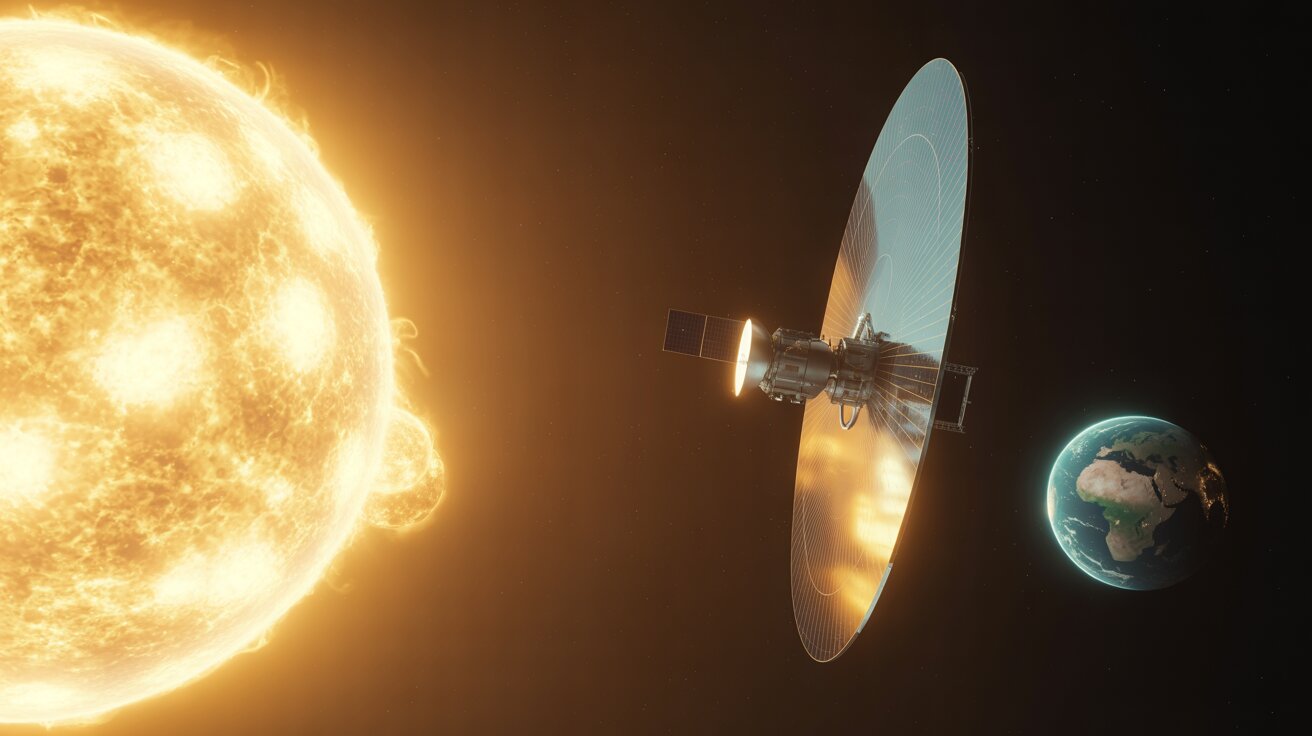
In January 2026, ACT! was approached by the L1 Working Group in Washington, DC, with a bold proposition: to establish a global-scale partnership aimed at advancing the design, development, and commercial-scale deployment of a 'sunshield' constellation of sunlight refractors at Lagrange Point One (L1) in space, to protect croplands from desertification.
The result was the execution of the L1 - Asian Climate Technologies (ACT!) VCC SunShield Project Agreement, establishing a formal collaboration between leading scientific, engineering, and business networks across the United States, Singapore, China, and beyond.
The Critical Challenge: Cropland Desertification
The science is clear. As global temperatures continue to rise, croplands worldwide are facing accelerating desertification. Given the increasingly probable scenario of a 2-3 degree Celsius increase in temperature (over pre-industrial levels) by 2060, with a projected catastrophic collapse of global food and water security by that time, the need for the successful development and deployment of this L1 - ACT! planetary sunshade Solution has never been more urgent.
Research presented by our L1 Working Group partners at the United Nations Conference on "Capping Climate Change from Space" held in New York on 28 July 2025 demonstrated that without intervention, critical agricultural regions will be rendered unviable within decades.
Ongoing rigorous thermodynamic analysis by the L1 Working Group shows that with continued desertification, global average soil surface temperatures could rise to levels that devastate food production. The consequences for global food security are profound.
The Solution: A Sunshield at Lagrange Point One
The concept builds on decades of peer-reviewed research, including work published by the University of Arizona, KTH Royal Institute of Technology, and others. A constellation of lightweight, translucent sunlight refractors - positioned at the L1 Lagrange point approximately 1.5 million kilometres from Earth, in-line between Earth and the Sun - would gently reduce solar flux reaching the Earth's surface.
A reduction of approximately 1.8% in solar flux is projected to fully offset the warming effect of a doubling of CO₂ concentrations. The sunshield approach offers distinct advantages over other geoengineering methods: it does not alter atmospheric or ocean chemistry, it is controllable and reversible, and it addresses the root cause of warming by managing incoming solar radiation.
Partnership Structure
The Agreement establishes a phased approach:
Phase 1 - The L1 Working Group contributes the underlying analysis of the Request for Quote (RFQ) and its scientific and engineering know-how. ACT! contributes its business network, which has already resulted in Tsinghua University's interest in the project, and leverages its professional network of investment associates to obtain a quote from the research network for the RFQ analysis.
Phase 2 - Upon completion of Phase 1, ACT! will form a dedicated business entity (ACT! SunShield, within the ACT! VCC global investments platform) to conduct detailed engineering design of both the L1 space infrastructure and the New CropLand (NCL) infrastructure on Earth.
Phase 3 - Commercial-scale implementation, with ACT! working with governmental, financial-sector, and industrial partners to bring the designs to reality.
The L1 Working Group Signatories
Contributing their combined scientific and engineering networks and resources for the Project:
- Dr. Alex J. Severinsky - Chairman Emeritus, PAICE Corporation, USA; Professor, University of Maryland; ACT! Global Advisory Board Member. Pioneer in hybrid-electric vehicle technology (inventions licensed in tens of millions of cars). Author of *The Desertification of Croplands* (2022, translated into seven languages). Co-author of the RFQ and co-presenter at the UN Conference "Capping Climate Change from Space" (July 2025).
- Dr. Allen L. Sessoms - Former scientific associate at CERN (European Organization for Nuclear Research); Director of the Office of Nuclear Technology and Safeguards at the US State Department; Deputy US Ambassador to Mexico; former President of Queens College (CUNY), Delaware State University, and University of the District of Columbia. Co-presenter at the UN Conference "Capping Climate Change from Space" (July 2025).
- Dr. Michael D. McDonald - Chairman & CEO, OVIAR Global Resilience Systems Inc.; Executive Director, Health Initiatives Foundation, Washington, DC. Former Head of the US National Health Information Infrastructure Consortium and the US Medical Technology Policy Committee (IEEE). Currently coordinates nearly 900 Resilient America Community site dashboards across the US.
The ACT! SunShield Project Signatories
Contributing their business and financial investment networks and resources for the Project:
- Mr. Dinesh Senan - Founder & Executive Chairman, Asian Climate Technologies VCC (ACT!), Singapore.
- Professor Dr. Seeram Ramakrishna - ACT! Global Advisory Board Member; Xinghua Distinguished Chair Professor, Tsinghua University, Beijing, China. Ranked 11th globally in Nanoscience and Nanotechnology. Fellow of the Chinese Academy of Engineering, UK Royal Academy of Engineering, and Singapore Academy of Engineering.
- Dr. Iraj Isaac Rahmim - ACT! Global Chief Technology Officer. Past Director of the American Institute of Chemical Engineers (AIChE); past President of the International Association of Energy Economics. Referee for The Energy Journal and IJOGCT.
- Dr. Sanjay Kuttan - ACT! Global Advisory Board Member. Former Director of Strategy at the Global Center for Maritime Decarbonization (GCMD); former Head of DNV; Director of the Energy Market Authority of Singapore.
- Mr. David Chin - ACT! Co-founder and Group Head, Strategic Business Development, Singapore.
A Vision of Planetary Scale
The L1-ACT! SunShield Project represents a paradigm shift in how humanity addresses climate change - moving beyond emissions reduction alone to actively managing the Earth's energy balance from space. Combined with parallel development of new croplands in regions identified through meteorological and geographical analysis, the project aims to secure global food production for future generations.
This partnership brings together world-class expertise in physics, thermodynamics, space engineering, resilience systems, nanotechnology, energy economics, and climate finance - united by the conviction that bold, science-driven action at planetary scale is both necessary and achievable.
The agreement was fully executed on 20 January 2026.