
A credible climate strategy must now confront an increasingly material question: can the world preserve sufficient productive cropland under conditions of rising radiative forcing, increasing land-surface heat, greater evapotranspiration, declining soil moisture, and more frequent extreme temperature events?
This question should matter not only to climate scientists and policymakers, but also to long-horizon investors. Cropland desertification is not merely an environmental endpoint. It is a mechanism through which climate stress propagates into food inflation, commodity volatility, sovereign fragility, migration pressure, infrastructure strain, insurance losses, and broader geopolitical instability. From a capital-allocation perspective, it is therefore appropriate to analyse cropland protection as a strategic resilience problem with planetary-scale externalities.
Decarbonization Alone Is Not Sufficient
Decarbonization remains indispensable. Long-run stabilization of the climate system is not achievable without sustained reductions in carbon dioxide, methane, nitrous oxide, and other anthropogenic greenhouse gases. Humanity is making progress on this front, albeit far too slowly, and efforts must double down.
However, mitigation alone does not remove the problem of thermal inertia — and, critically, greenhouse gas emissions are only one of several sources of extra heating acting on the Earth. The much larger source of warming comes from the Earth system itself. Water vapour amplifies the greenhouse effect. Melting ice reduces the planet's reflectivity, exposing darker ocean and land surfaces that absorb more solar energy. Desertification replaces reflective vegetation with heat-absorbing bare soil. Changes in cloud cover alter the radiative balance further still.
Historically, these Earth-system responses are referenced to the effect of greenhouse gases as a climate feedback, and the feedback coefficient is large — ranging from over 2 to as high as 5. In practical terms, this means that natural amplification effects add at least as much additional heating as the greenhouse gases themselves, and potentially up to four times more. The implication is sobering: even if anthropogenic emissions were halted entirely, the Earth-system feedbacks already in motion would continue to drive warming for decades.
And these are forces beyond human control. We cannot govern El Niño oscillations, halt hurricanes, redirect typhoons or tornadoes, reverse the expansion of the Sahara, or prevent icebergs from calving into warming oceans. These are autonomous processes of a planetary system under thermal stress.
Why Solar Shading — and Why at L1
If we cannot control the Earth's own amplifying mechanisms, the question becomes: what can we do? The only natural mechanism that directly counters heating is to reduce the amount of sunlight reaching the Earth's surface. The principle is intuitive — it is much cooler at night. The challenge is where and how to place a shade.
Several approaches have been proposed, each with fundamentally different characteristics. In the most extreme cases, particulate matter such as sulphate aerosols could be sprayed into the stratosphere to reflect sunlight — but this must be repeated annually, carries significant risks of atmospheric chemistry disruption, and raises profound governance concerns. At various orbital positions between the L1 Lagrange point and the Earth, a shade could theoretically be stationed, but fuel would be required continuously to maintain its position against gravitational drift.
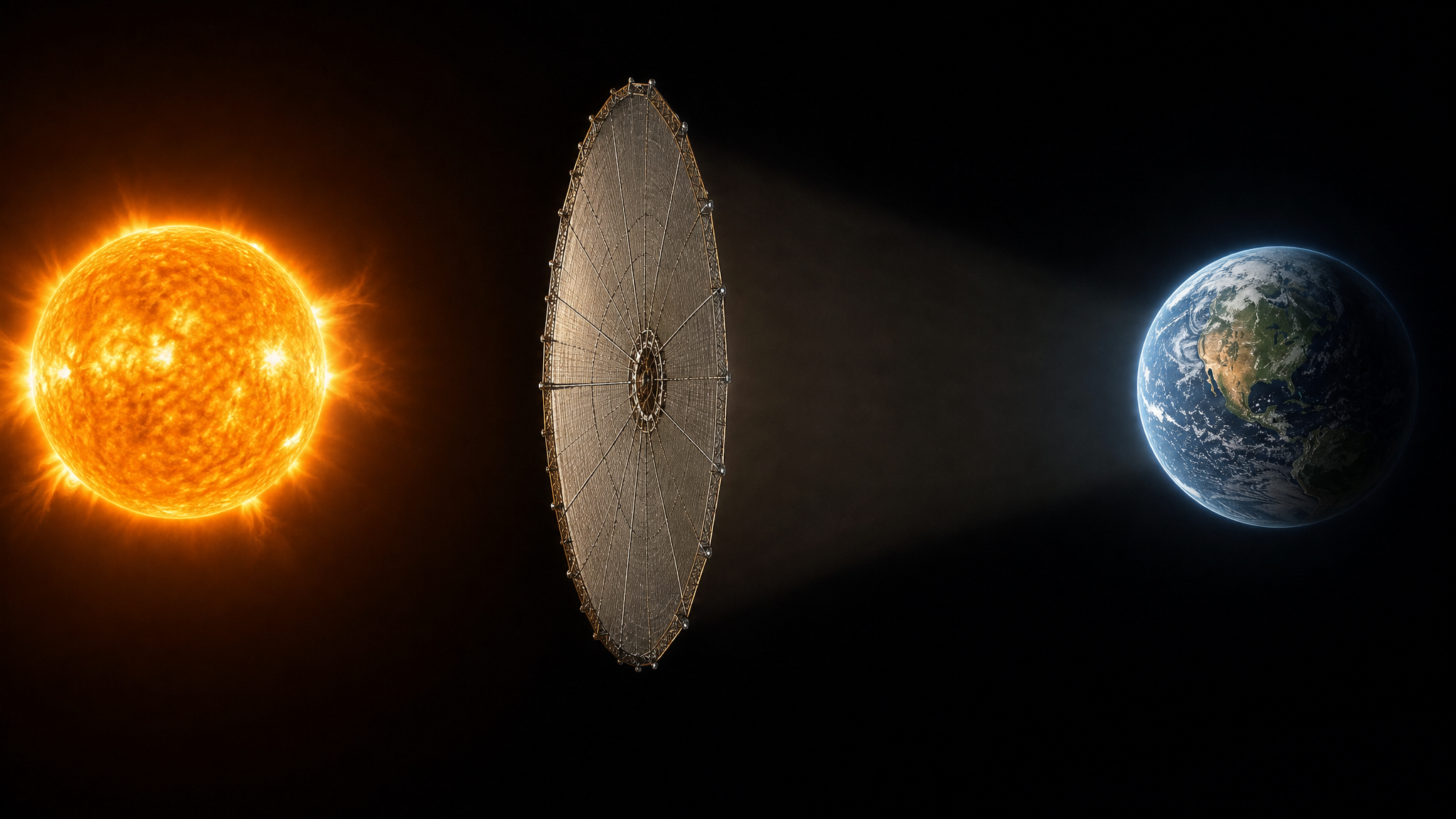
The L1 Lagrange point — located approximately 1.5 million kilometres from Earth, where the gravitational pull of the Sun and Earth balance — offers a uniquely elegant solution. A structure placed at L1 can theoretically remain in position for decades with minimal station-keeping, making it the minimum-effort solution for sustained solar radiation management. In concept, a distributed constellation of lightweight refractive or reflective elements deployed near L1 could modestly reduce incident solar flux before it reaches the Earth system. The scientific rationale derives from first principles of radiative balance: if positive forcing from greenhouse gases and amplifying Earth-system feedbacks raises equilibrium and transient temperatures, then a calibrated reduction in incoming shortwave radiation may offset part of that forcing and thereby reduce surface thermal stress.
Direct Relevance to Cropland Protection
The relevance of this concept to cropland protection is direct. Agricultural viability is strongly influenced by the surface energy balance, boundary-layer conditions, vapour-pressure deficits, soil-moisture persistence, and the frequency and duration of heat excursions beyond crop tolerance thresholds. Even relatively small changes in thermal loading can influence evapotranspiration rates, water stress, and yield stability, particularly in already vulnerable agroecological zones. A modest reduction in solar input, if properly calibrated and modelled, could therefore have disproportionate value in slowing the progression of land degradation in critical food-producing regions.
This is not an argument for substitution. An ACT! - L1 SunShield, if ever demonstrated to be feasible, should be understood as complementary to emissions reduction, adaptation, water management, crop-system transition, and resilience planning. Nor is it an argument for technological exceptionalism. Any proposal of this scale must be judged by evidence, scenario analysis, engineering constraints, institutional legitimacy, and governance quality.
Why Investors Should Pay Attention
From an investor perspective, the concept warrants attention for four reasons.
First, the exposure is systemic. Cropland degradation affects multiple asset classes and jurisdictions simultaneously through food systems, trade channels, social stability, and public-finance stress. This creates a macro-relevance that is unusual even within climate investing.
Second, the intervention is legible as infrastructure. It can be assessed using established frameworks for phased development, capital deployment, technical readiness, operating risk, reliability, and avoided-loss economics.
Third, the thesis is analytically tractable. It can be studied through coupled climate modelling, land-surface and crop-response modelling, orbital mechanics, materials engineering, launch logistics, and probabilistic cost estimation.
Fourth, the option value may be substantial. Where downside climate risk is large and potentially irreversible on human timescales, it is rational to investigate whether a technically demanding but controllable intervention could reduce extreme-loss scenarios.
These considerations underpin ACT!'s global partnership with the L1 Working Group in Washington, D.C. Our position is not that the answer is already known. Our position is that the question is sufficiently important to justify serious work across science, engineering, finance, and governance.
Five Domains of Rigorous Evaluation
In practical terms, rigorous evaluation should proceed across five domains.
First, radiative and climatic modelling. It is necessary to quantify how different levels and geometries of solar-flux reduction would propagate through the atmosphere-ocean-land system, including effects on regional temperature distributions, precipitation, cloud feedbacks, monsoon behaviour, and hydrological variability.
Second, agricultural systems analysis. Cropland outcomes must be evaluated not only through global mean temperature changes, but through region-specific impacts on soil moisture, vapour-pressure deficit, growing-degree patterns, crop failure thresholds, and yield volatility.
Third, engineering and operations. A credible L1 architecture requires disciplined analysis of reflector or refractor design, mass budgets, manufacturing requirements, launch cadence, orbital insertion, station-keeping, degradation rates, repairability, and end-of-life protocols.
Fourth, techno-economics. Rough-order cost estimates should be expanded into capital-stack analysis, deployment phases, scenario-based cost curves, sensitivity ranges, and comparisons with the expected economic damage associated with accelerated cropland loss and food-system instability.
Fifth, governance and institutional design. No intervention of this kind should advance without transparent international oversight, explicit decision rights, monitoring systems, liability frameworks, and clear conditions for modulation or termination.
The Case for Disciplined Investigation
The practical case for evaluation is therefore straightforward. If cropland desertification represents a credible threat to long-term economic and social stability, and if a space-based reduction in incident solar radiation may help reduce that threat, then disciplined investigation is a prudent response. The failure to study such an option would itself be a consequential strategic choice.
The climate challenge will not be solved by narrative alone. It will be shaped by whether capital, science, and governance can be aligned around the preservation of productive land, reliable food systems, and social continuity. In that context, the ACT! - L1 SunShield deserves careful attention not as a speculative gesture, but as a potentially material resilience instrument whose feasibility should be established - or rejected - on the basis of rigorous evidence.